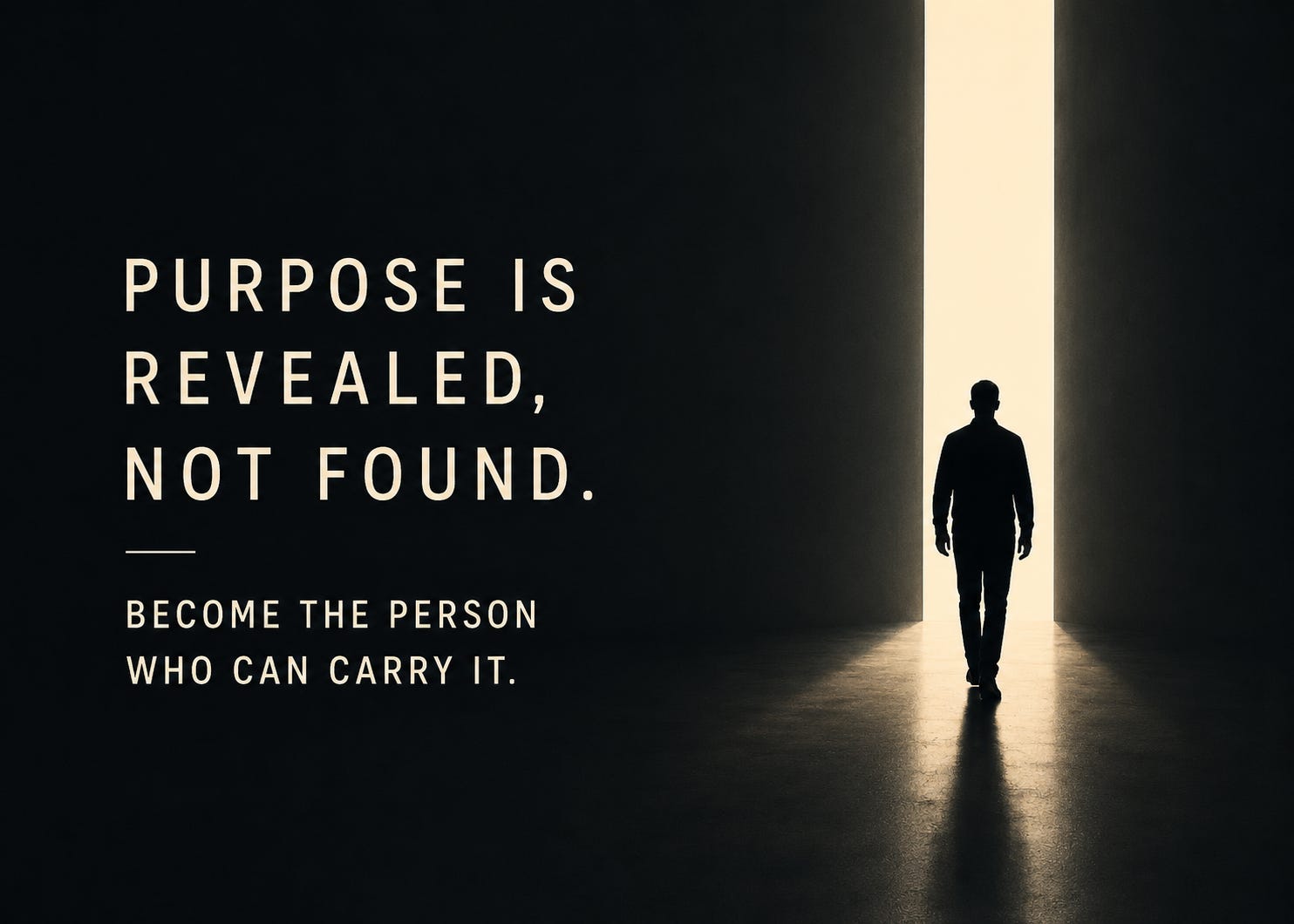
Stop Looking for Your Purpose. Build a Life That Forces It to Reveal Itself.
Most people do not need another purpose exercise. They need honesty, standards, responsibility, and the courage to stop living a life that no longer fits.

People ask me about purpose all the time.
Not always directly, of course.
Sometimes they dress it up.
“What is my purpose in life?”
“How do I discover what I am supposed to do?”
“How do I know what I really want?”
“What should I do when I feel stuck?”
“How do I leave a legacy?”
“How do I make the world a better place?”
“How do I zero in on my strengths?”
“How do I live according to my own standards instead of constantly reacting to everybody else’s?”
And then, eventually, the question comes.
“Do you know what your purpose is?”
I usually smile.
Not because the question is silly.
It is not silly at all.
It is one of the most dangerous questions a person can ask.
Dangerous, because most people do not want the real answer.
They want a sentence.
They want a beautiful statement they can put in a journal, repeat in the mirror, maybe post under a black and white photo of themselves looking meaningfully into the distance.
They want purpose to sound like a brand slogan.
“My purpose is to inspire others.”
“My purpose is to heal.”
“My purpose is to empower people.”
“My purpose is to create abundance.”
Fine.
Lovely.
Very soft lighting.
Very beige.
Very LinkedIn retreat in Sedona.
But purpose is not something you find because you sat quietly for twenty minutes and asked the universe to send you a notification.
Purpose is not a treasure buried somewhere inside you, waiting for you to dig with a scented candle and a podcast subscription.
Purpose is not discovered in comfort.
Purpose is revealed under pressure.
Purpose shows up when your life stops performing for you.
When the applause disappears.
When the money gets strange.
When the marriage breaks.
When the plan collapses.
When the room that once welcomed you stops calling.
When you are no longer distracted by being busy and suddenly have to deal with the terrifying silence of your own life.
That is when people start asking about purpose.
Not when life is working.
When life is no longer numbing them.
People say they are searching for purpose.
Often, they are actually searching for permission.
Permission to change.
Permission to stop pretending.
Permission to admit that what they built no longer fits.
Permission to walk away from the life that impressed others but exhausted them privately.
Permission to say, “This is not it.”
That sentence frightens people.
“This is not it.”
Because once you say it, you can no longer hide inside the old version of yourself.
You can no longer blame confusion.
You can no longer pretend you are waiting for clarity.
Clarity is not always a light.
Sometimes clarity is a wrecking ball.
I get asked about Ikigai, too.
That Japanese concept people love to turn into a four-circle diagram.
What you love.
What you are good at.
What the world needs.
What you can be paid for.
It is a useful framework.
But like most useful things, the internet turned it into a decorative pillow.
People stare at the diagram as if it is going to solve their life.
It will not.
Ikigai is not magic.
It is not a personality quiz with better manners.
It is not a cute intersection where passion, profession, mission, and vocation all hold hands and sing.
The real question is much harsher.
What can you do well, repeatedly, under pressure, when nobody claps?
What problem keeps bothering you even when it is not profitable yet?
What injustice, stupidity, waste, weakness, beauty, talent, or possibility do you keep seeing before others see it?
What do people naturally bring to you because, somehow, you see through the fog faster than they do?
What would you still care about if it did not make you look impressive?
There.
Now we are getting closer.
Purpose is not fantasy.
Purpose has evidence.
People love saying, “I do not know what my purpose is.”
I understand that.
But often, they are not looking at the evidence.
They are looking at their mood.
Bad idea.
Your mood is weather.
Your patterns are evidence.
Look at what you keep returning to.
Look at what bothers you.
Look at what you cannot unsee.
Look at where people keep asking for your help.
Look at what you learn faster than most.
Look at what you can explain clearly without trying to sound smart.
Look at what makes you impatient because the answer is obvious to you, but somehow invisible to others.
Your strengths are not always what you enjoy.
Sometimes your strengths are what irritate you, because you cannot understand why other people keep making such a mess of something you can see so clearly.
That irritation can be information.
Not always virtue, of course.
Sometimes you are just cranky.
I know. Tragic.
But sometimes the thing that annoys you is the thing you are meant to improve.
The world does not need more people pretending to have a purpose.
It needs people who become useful at something real.
That is where this entire conversation usually goes wrong.
People want purpose to make them feel important.
Purpose, if it is real, makes you responsible.
That is a much less comfortable product to sell.
Purpose does not ask, “How can I feel more special?”
Purpose asks, “What am I willing to carry?”
Big difference.
Everybody wants to leave a legacy.
Wonderful.
But legacy is not what people say about you after you are gone.
That is reputation with candles.
Legacy is what continues to work because you existed.
A person you helped think more clearly.
A business you built that still feeds families.
A child who inherited courage instead of confusion.
A standard you refused to lower.
A truth you said when silence would have been more convenient.
A body of work that still has teeth when you are not in the room to defend it.
That is legacy.
Not a plaque.
Not a quote.
Not a charitable dinner where people mispronounce your name while eating overcooked fish.
Legacy is the residue of your standards.
And that brings us to the part most people avoid.
Purpose is impossible without standards.
Not public standards.
Internal standards.
The ones nobody sees.
The ones that cost you something.
How do I live according to my own internal standards?
That is one of the best questions a person can ask.
Because if you do not have internal standards, the world will rent your nervous system and decorate it however it wants.
Your friends will define success for you.
Your family will define duty for you.
Social media will define beauty for you.
Your industry will define ambition for you.
Your wounds will define love for you.
Your bank account will define worth for you.
And then one day you wake up wondering why you feel like a stranger inside a life you technically chose.
That is not purpose.
That is compliance with better furniture.
Living by internal standards means you stop outsourcing your compass.
It means you no longer need every room to understand you.
It means you can disappoint people without automatically assuming you did something wrong.
It means you can say no without writing a legal brief.
It means you do not confuse being liked with being aligned.
It means you stop treating other people’s confusion as evidence against your clarity.
That takes self-mastery.
Not the ridiculous version where someone wakes up at 4:17 AM, takes a cold plunge, writes in a leather journal, lifts weights, drinks mushroom foam, and then spends the rest of the day posting about discipline.
Real self-mastery is less cinematic.
It is noticing when you are lying to yourself.
It is catching your own excuses before they become identity.
It is knowing the difference between rest and avoidance.
It is understanding when you are tired because you worked hard, and when you are tired because you keep betraying yourself.
That second kind of exhaustion is different.
People call it burnout.
Sometimes it is.
But sometimes burnout is not from doing too much.
Sometimes burnout is from doing too much of what no longer feels true.
That is a very different problem.
A vacation will not fix a false life.
Neither will another productivity system.
Neither will a new notebook, a new app, a new morning routine, or one more person on YouTube telling you to optimize your dopamine.
At some point, you have to ask the brutal question.
Am I tired because the work is hard, or am I tired because the work is meaningless to me now?
That question has teeth.
Especially in midlife.
Midlife is not a crisis because people suddenly become dramatic.
Midlife is a crisis because the lies stop working.
The ambitions you borrowed start expiring.
The applause you chased starts sounding thin.
The life you constructed to prove something to someone who may not even be paying attention anymore begins to feel absurd.
You look around and think, “I did what I was supposed to do. Why does this feel so empty?”
That is not failure.
That is a summons.
A rude one, perhaps.
But still a summons.
Feeling stuck is not always a sign that your life is over.
Sometimes it is a sign that the old operating system is finished.
You cannot keep running a new life on old code.
People ask, “How do I know what I want to do?”
My answer is not romantic.
Start by admitting what you no longer want to keep pretending.
That is often easier than identifying your grand purpose.
What do you no longer want to perform?
What conversation are you tired of having?
What room makes you shrink?
What success no longer impresses you?
What version of yourself are you exhausted from maintaining?
Purpose often begins with disgust.
Not the pretty kind.
The private kind.
The kind where you finally say, “I cannot keep doing this.”
Good.
That is not weakness.
That is the beginning of honesty.
From there, you do not need to find your entire purpose by Friday.
You need to move toward evidence.
Take responsibility for your strengths.
That sounds obvious.
It is not.
Many people know their strengths, but they treat them casually.
They keep waiting for someone else to name them, validate them, package them, and invite them onto a stage.
No.
If you can see clearly, use it.
If you can communicate, communicate.
If you can build, build.
If you can organize chaos, stop pretending chaos is normal.
If you can lead, lead.
If you can heal, heal with discipline, not theatrics.
If you can sell, sell something worthy.
If you can create, create something that does not insult your own intelligence.
If you can teach, teach what you actually know, not what is trending this week.
Your strengths are not decorations.
They are obligations.
This is where “making the world a better place” becomes practical.
I have always been suspicious of people who say they want to make the world a better place but cannot make a room better when they enter it.
Start there.
Make the room better.
Make the conversation more honest.
Make the business more intelligent.
Make the product more useful.
Make the family less chaotic.
Make the client more capable.
Make the employee more confident.
Make the idea sharper.
Make the standard higher.
Make the work cleaner.
The world is not improved only by grand humanitarian speeches.
It is improved by people who refuse to add more stupidity, laziness, vanity, dishonesty, and cowardice to the pile.
That may not sound spiritual enough.
Good.
Most spiritual language has become a hiding place for people who do not want to do the hard, ordinary work of becoming reliable.
Purpose requires usefulness.
Usefulness requires competence.
Competence requires repetition.
Repetition requires discipline.
Discipline requires standards.
Standards require identity.
And identity requires a decision.
Not a mood.
A decision.
Who am I going to be when nobody rewards me immediately?
That is where purpose lives.
Not in the fantasy of impact.
In the practice of becoming the kind of person who can be trusted with impact.
I do know my purpose.
But I do not carry it around like a slogan.
I do not need to put it on a bracelet.
My purpose has revealed itself through the things I have built, lost, studied, rebuilt, challenged, survived, observed, and refused to accept.
I have sat in rooms where money was real.
Not motivational-speaker real.
Real real.
I have seen what success does to people.
I have seen what pressure exposes.
I have seen people become rich and still remain poor in judgment.
I have seen people get opportunity and destroy it because their character could not carry the weight.
I have seen people chase status because they had no internal standard.
I have watched brilliant people wander aimlessly because they were waiting to feel ready.
I have watched talented people waste decades trying to be understood by people committed to misunderstanding them.
I have watched people search for purpose while avoiding the one thing that would reveal it.
Responsibility.
So yes, I know my purpose.
Part of it is to cut through illusion.
Part of it is to help people see themselves without the flattering lighting.
Part of it is to build, communicate, provoke, challenge, and create standards where the world keeps lowering them.
Part of it is to say the thing people feel but do not know how to articulate yet.
Part of it is to help people stop wandering through their own lives like visitors.
Purpose is not always soft.
Sometimes purpose is a blade.
It cuts away what is false.
That is why so many people avoid it.
They say they want purpose, but what they really want is comfort with a nobler name.
Real purpose will rearrange your life.
It may cost you relationships built on your old obedience.
It may cost you approval from people who liked you better confused.
It may cost you the identity you used to perform.
It may cost you the luxury of blaming everyone else.
But it gives you something far better.
Direction.
And direction is underrated.
People think happiness is the goal.
I am not against happiness.
I enjoy a good day like anyone else.
But happiness is unstable.
Direction is stronger.
A person with direction can survive difficult seasons.
A person without direction needs constant distraction.
That is why so many people feel stuck.
Not because they lack talent.
Not because they lack potential.
Not because the universe forgot to assign them a mission.
They feel stuck because they keep negotiating with a life that no longer requires their full truth.
And deep down, they know it.
So what is your purpose?
Start smaller.
Start sharper.
What do you see that others miss?
What do people come to you for?
What standard do you refuse to lower?
What problem keeps following you?
What strength have you been treating like a hobby when it is actually a responsibility?
What lie are you tired of living?
What would you build, say, teach, repair, expose, create, protect, or improve if you stopped waiting for permission?
Do not ask the universe for a purpose while ignoring the evidence of your own life.
It has been speaking.
Through your frustration.
Through your gifts.
Through your repeated patterns.
Through your disappointments.
Through your envy.
Through your anger.
Through your exhaustion.
Through the strange pull toward something you keep dismissing because it would require you to become more serious.
Purpose is not hiding.
You are.
And the moment you stop hiding, life becomes less vague.
Not easier.
Less vague.
That is enough.
Because once you can see the direction, you can begin.
And once you begin, purpose stops being a question.
It becomes a standard you live by.
Daily.
Privately.
Relentlessly.
Until one day people ask you, “How did you find your purpose?”
And you realize the truth.
You did not find it.
You became the person who could finally carry it.